
The Somerton Man
The Somerton Man refers to an unidentified man found deceased at Somerton Beach, near Adelaide, South Australia, in December 1948. His death remains one of Australia’s most puzzling unsolved cases, with investigators unable to determine his identity or the exact cause of death.[1]
| Somerton Man | ||
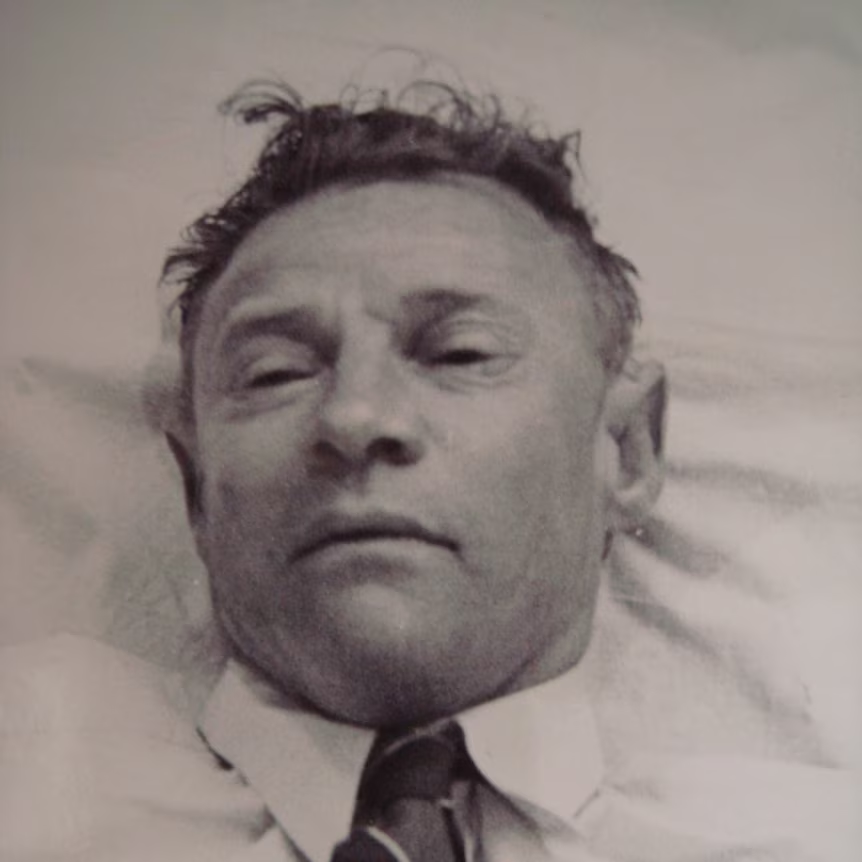 | ||
| Somerton Man | ||
| Born | Unknown Unknown | |
| Died | December 1948 Somerton Beach, Adelaide, South Australia, Australia | |
| Cause of death | Suspected poisoning (unconfirmed)[2] | |
| Resting place | Adelaide, South Australia (unmarked grave) | |
| Other names | Unknown Man, Tamam Shud case | |
| Known for | Mysterious death at Somerton Beach; unsolved identity | |
| Occupation(s) | Unknown[3] | |
| Hair color | Ginger-mousy, greying at sides | |
| Eye color | Grey | |
| body_features | Clean-shaven, physically fit, uncircumcised, scars on left arm, 16 missing teeth[4] | |
Discovery
On an early December morning, a man’s body was discovered against the seawall of Somerton Beach. Passersby the evening prior had assumed he was asleep due to intoxication. By the time the police arrived, the body was stiff, and the pathologist estimated death occurred around 2 a.m. There were no apparent signs of violence or struggle. A half-smoked cigarette was found on his collar, and the surrounding sand remained undisturbed.[5]
Investigation and Inquest
Initial reports in local newspapers drew little attention, but as questions about the man’s identity and manner of death persisted, public interest increased. Six months later, the Adelaide city coroner, Professor Thomas Cleland, noted that the man’s identity was completely unknown and that his death was neither natural nor accidental.[6] Despite numerous investigations over decades, including a renewed search by a senior detective in recent years, the Somerton Man remains unidentified.[7]
Historical and Analytical Context
The case highlights the challenges historians face when subjects are unknowable. With few archival traces, much of the reconstruction relies on circumstantial evidence and contextual speculation. Scholars such as Natalie Zemon Davis and Alain Corbin have explored similar methodologies, using fragmentary sources to reconstruct the worlds of elusive historical figures, focusing less on complete biographies and more on the broader cultural and social environment.[8]
Physical Description
The Somerton Man was estimated to be around forty-five years old, physically fit, clean-shaven, uncircumcised, with grey eyes and greying hair. He had missing teeth, small scars on his left arm, and well-developed calves. He was noted to maintain personal hygiene, including clean shoes and nails. Evidence of heavy smoking was present, along with a half-smoked cigarette on his collar and another tucked behind his ear. Personal effects included a packet of cigarettes, a box of matches, two combs, a bus ticket, a railway ticket, and a pack of chewing gum. Clothing labels had been removed, leaving no clue to his identity.[9]
Cause of Death
The inquest suggested that poisoning was the most likely cause of death, although no common poisons were detected. The unusual nature of the death, along with the absence of evidence of struggle, led the coroner to conclude that the motives for his death—whether self-inflicted or inflicted by another—remained unknown.[10]
Public and Historical Responses
The case attracted numerous letters from the public, with individuals claiming to recognize the man as missing relatives or acquaintances. None of these claims were verified. The discovery of an unclaimed suitcase, matched to the Somerton Man through sewing thread analysis, provided a small link to his last known movements but did not reveal his identity.[11]
Initial Investigation
During the inquest that followed, police discovered train tickets in the man’s pockets indicating travel to Adelaide from another city the day before his death. A suitcase found in the Adelaide Railway Station’s luggage room was traced to him, containing neatly packed clothing with the tags removed. One of his coats appeared to have been made in the United States, though this clue led nowhere definitive. No wallet, passport, or identification tags were ever found.[12]
A particularly puzzling piece of evidence came when investigators discovered a small hidden fob pocket in the man’s trousers containing a rolled-up piece of paper with the words “Tamam Shud,” meaning “the end” in Persian. The phrase originated from a translated copy of the 11th-century poem collection
• The Rubaiyat of Omar Khayyam*. The torn page was eventually matched to a copy of the book found discarded in a car. On the inside cover of the book were scribbled letters thought to be a code and a local telephone number, which led police to a woman in the nearby suburb of Glenelg. She denied knowing the man but was reportedly distressed upon seeing his plaster cast.[13]
The “Tamam Shud” Clue
The Persian phrase “Tamam Shud” has long fascinated investigators and readers alike. It appeared to symbolically mark the end of the man’s life and was torn from The Rubaiyat, a work known for its meditations on fate and mortality. The letters written inside the book were analyzed as possible codes, but none have been successfully deciphered. Early theories suggested espionage links, but no intelligence records ever supported such claims.[14]
DNA Identification and Research
Decades later, renewed interest in the case led to scientific advances that made re-examination possible. In 2011, Derek Abbott of the University of Adelaide obtained permission from South Australian authorities to study hair samples preserved in a plaster “death mask” made of the man’s face shortly after his autopsy. These strands, trapped in the plaster, contained sufficient DNA for analysis. Abbott and his research team worked for years to extract viable sequences.[15]
Abbott later collaborated with Colleen Fitzpatrick, a leading figure in forensic genealogy. Using the extracted DNA and genealogical databases, they constructed an intricate family tree containing roughly 4,000 individuals. In 2022, they announced that the DNA evidence conclusively identified the Somerton Man as Carl “Charles” Webb, born 16 November 1905 in Footscray, Victoria. Webb was an electrical engineer and instrument maker, the youngest of six children, and married to Dorothy “Doff” Robertson. Public records show that Webb separated from his wife around 1947, after which he disappeared from official documentation.[16]
Connection to South Australia
Fitzpatrick and Abbott’s genealogical research revealed that Webb’s estranged wife, Dorothy, had moved to Bute, South Australia, by 1951. This provided a possible reason for Webb’s presence in Adelaide. Abbott suggested that Webb may have traveled to the region seeking reconciliation with his wife, though there is no definitive evidence for this theory.[17]
Reinterpretation of the Clues
The identification of Webb also prompted reinterpretations of long-standing mysteries surrounding the case. Abbott suggested that Webb’s interest in horse racing might explain the cryptic code-like letters found in the
• Rubaiyat
• —possibly shorthand for horse names or betting combinations. Webb’s known appreciation for poetry may also clarify his possession of the Rubaiyat and its philosophical verse.[18]
Continuing Questions
Although the DNA results strongly support Webb’s identification, the cause of his death remains unresolved. Toxicological evidence from the original autopsy was inconclusive, and modern testing on the exhumed remains may yield further insights. Abbott and Fitzpatrick continue to call for complete toxicological analysis to determine whether Webb died by suicide, poisoning, or natural causes.[19]
References
- Balint, Ruth. The Somerton Man: An Unsolved History. Cultural Studies Review 16(2), September 2010, pp. 159–178.
- Balint, Ruth. "The Somerton Man: An Unsolved History." Cultural Studies Review 16(2), 2010, pp. 159–178.
- Balint, 2010, p. 164.
- Balint, 2010, pp. 163–164.
- Balint, 2010, p. 160.
- Balint, 2010, p. 160.
- Balint, 2010, p. 160–161.
- Balint, 2010, p. 161–162.
- Balint, 2010, p. 163–164.
- Balint, 2010, p. 164.
- Balint, 2010, p. 167.
- Whiteman, Hilary. CNN, July 26, 2022, pp. 9–11.
- Whiteman, Hilary. CNN, July 26, 2022, pp. 12–17.
- Whiteman, Hilary. CNN, July 26, 2022, pp. 18–20.
- Whiteman, Hilary. CNN, July 26, 2022, pp. 21–25.
- Whiteman, Hilary. CNN, July 26, 2022, pp. 26–32.
- Whiteman, Hilary. CNN, July 26, 2022, pp. 33–36.
- Whiteman, Hilary. CNN, July 26, 2022, pp. 37–41.
- Whiteman, Hilary. CNN, July 26, 2022, pp. 42–44.