
Sydney Opera House
| Sydney Opera House | ||
 | ||
| Location | Bennelong Point, Sydney, New South Wales, Australia | |
| Architect | Jørn Utzon | |
| Structural engineer | Ove Arup and Partners | |
| Construction start date | 1957 | |
| Completion date | 1973 | |
| Opened date | 20 October 1973 | |
| Owner | Government of New South Wales | |
| Cost | Approximately A$102 million | |
| Seating capacity | Multiple venues, over 5,000 combined | |
| National Heritage listing | National Heritage List | |
| Heritage listing date | 12 July 2005 | |
| World Heritage listing | World Heritage List | |
| World Heritage listing date | 2007 | |
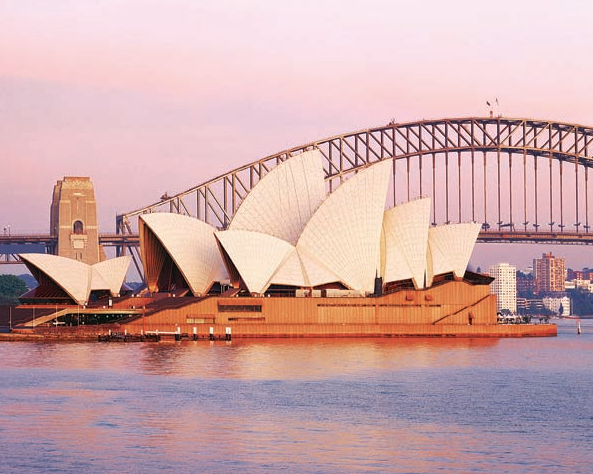
The Sydney Opera House is a performing arts centre located on Bennelong Point in Sydney, New South Wales, Australia. Recognised as the nation's most distinctive building, its white, sail-like roof structures have made it an international symbol of Australia’s cultural identity.[1]
The Opera House occupies a prominent position by Sydney Harbour, adjacent to the Sydney Harbour Bridge, forming one of the most iconic urban panoramas in the world.[2]
In 1956, the New South Wales Government launched an international competition to design a “National Opera House.” From 233 entries across 33 countries, the winning design was submitted by 38-year-old Danish architect
• *Jørn Utzon**. The judges declared that his concept was capable of producing “one of the great buildings of the world.”[3]
The engineering firm **Ove Arup and Partners** undertook the challenge of bringing the ambitious design to life. Construction spanned 16 years and pushed the limits of architectural and structural engineering of the time. Cost overruns and design changes led to significant controversy throughout the building’s development.[4]
To help finance the project, the **Opera House Lottery** was established, raising approximately $101 million through 496 draws—nearly matching the final cost of the building.[5]
The most complex technical challenge was designing and constructing the roof’s sculptural, sail-like shells. It took Utzon and Ove Arup more than four years to develop a viable geometric solution. Once achieved, earlier construction work had to be revised and strengthened to support the redefined roof structure.[6]
Mounting tensions between Utzon and the New South Wales Government culminated in his resignation in 1966. The completion of the Opera House was subsequently managed by architects Peter Hall, Lionel Todd, and David Littlemore.[7]
The building houses a variety of performance spaces, including a **Concert Hall**, **Opera Theatre**, **Drama Theatre**, **Playhouse**, and **Studio**. It was officially opened by **Queen Elizabeth II** on **20 October 1973** and has since hosted over 2,000 events annually, attracting around two million patrons each year.[8]
The Sydney Opera House stands as an enduring symbol of artistic vision, governmental ambition, engineering ingenuity, and the aspirations of the Australian people. It was added to the **National Heritage List** on **12 July 2005** and the **World Heritage List** in **2007**.[9]
References
- Australia's National Heritage – Sydney Opera House, Australian Heritage Council, pp. 14.
- Australia's National Heritage – Sydney Opera House, Australian Heritage Council, pp. 14.
- Australia's National Heritage – Sydney Opera House, Australian Heritage Council, pp. 14.
- Australia's National Heritage – Sydney Opera House, Australian Heritage Council, pp. 14.
- Australia's National Heritage – Sydney Opera House, Australian Heritage Council, pp. 14.
- Australia's National Heritage – Sydney Opera House, Australian Heritage Council, pp. 14.
- Australia's National Heritage – Sydney Opera House, Australian Heritage Council, pp. 14.
- Australia's National Heritage – Sydney Opera House, Australian Heritage Council, pp. 14.
- Australia's National Heritage – Sydney Opera House, Australian Heritage Council, pp. 14.