
Sydney Harbour Bridge
| Sydney Harbour Bridge | ||
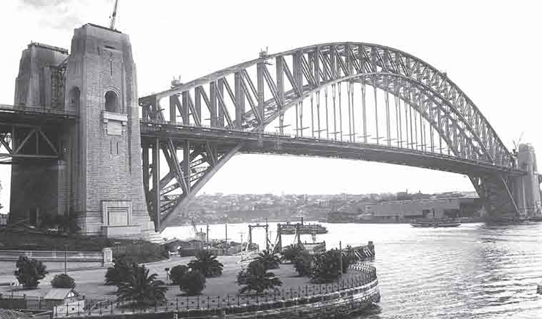 | ||
| A view of the Sydney Harbour Bridge | ||
| Official name | Sydney Harbour Bridge | |
| Carries | road, rail, bicycle and pedestrian traffic | |
| Crosses | Port Jackson (Sydney Harbour) | |
| Locale | Sydney, New South Wales, Australia | |
| Owner | Government of New South Wales | |
| Maintained by | Roads and Maritime Services (RMS) | |
| Design | Steel through arch bridge | |
| Material | Steel | |
| Designer | Dorman Long and Co. Ltd (main contractor) | |
| Length | 1,149 metres | |
| Main span | 503 metres | |
| Construction began | 1923 | |
| Construction completed | 1932 | |
| Opened | 19 March 1932 | |
| Traffic type | mixed road, rail, cycle and pedestrian | |
The Sydney Harbour Bridge is a steel through arch bridge in Sydney, New South Wales, Australia, carrying rail, vehicular, bicycle and pedestrian traffic between the Sydney central business district and the North Shore. The structure is one of the city's most recognisable landmarks and a major feat of early twentieth-century engineering. The basic chronology, design features, construction timeline and opening are summarised below and are taken from the uploaded RMS short history of the bridge. [1]
History
Planning and design
Planning for a permanent harbour crossing began in the late 19th and early 20th centuries in response to growing transport needs across Port Jackson. Various proposals were considered, including tunnels and different bridge forms. By the 1910s and 1920s the steel arch design was chosen as the optimal solution for the required span, clearance and construction practicality. The project was developed under state government authority, with major contract work awarded to experienced bridge-builders and engineers. [2]
Construction
Construction of the bridge began in the early 1920s. Major components included large steel arch ribs, which were fabricated and erected from both sides of the harbour and completed at mid-span. Substantial approach spans and roadways, rail tracks and the supporting piers were constructed in parallel. The construction programme employed thousands of workers, used significant quantities of steel and concrete, and required complex temporary works and lifting arrangements for the arch segments. The work continued through the late 1920s and into the early 1930s. [3]
Captain Francis de Groot
Premier Jack Lang's government declared the opening of the Bridge a public holiday, allowing all of Sydney to join the celebrations. The day was bright and sunny, attracting the largest crowd the city had seen up to that time.
The arch and deck were fully completed, and the ceremony began at 10 a.m. Lang chose to perform the opening himself rather than have a British royal representative do so.
During the event, Captain Francis de Groot suddenly rode forward on horseback and cut the ceremonial ribbon, stating, "I open this bridge in the name of His Majesty the King and all decent people." He was quickly removed, and the ribbon was then replaced and officially cut by Lang.
A parade followed across the Bridge, and afterward, around one million pedestrians crossed it.
Opening
The bridge was officially opened in March 1932 following completion of the major structural work and the finishing of road and rail approaches. The opening marked a major milestone in Sydney's transport history and had immediate and long-term impacts on the development of the city's suburbs and commuter patterns. [4]
Design and structure
The bridge is a steel through arch type with a single main arch spanning the central navigation channel. The arch supports the deck below through vertical hangers and carries multiple lanes of traffic and railway tracks. Design considerations included material strength, wind and fatigue performance, and the need for sufficient navigation clearance beneath the central span. The aesthetic massing of the arch was also an important civic consideration, producing the bridge's characteristic silhouette. [5]
Engineering Feat
Recognized as one of the world’s premier arch bridges, the Sydney Harbour Bridge features a 503-meter span and a 49-meter-wide deck, surpassing other major arch bridges in load capacity and mass. Designed to utilize Sydney’s sandstone foundation, it remains structurally sound, never reaching its full capacity. Under John Job Crew Bradfield’s leadership, the bridge combined innovative engineering with the site’s natural strengths, setting a global standard.
Social and Symbolic Role
The bridge serves as a focal point for national celebrations, from New Year’s Eve fireworks to the 2000 Reconciliation Walk, uniting communities. Envisioned by Bradfield as a space for national rejoicing, it holds a place in Australia’s identity comparable to global landmarks like the Eiffel Tower, embodying the nation’s spirit.
Bradfield’s Legacy
John Job Crew Bradfield, the bridge’s principal design engineer, ranks among Australia’s greatest engineers. His vision integrated the bridge into Sydney’s transport network, shaping urban development. His contributions earned accolades like the 1932 Peter Nicol Russell Medal and the 1934 Telford Gold Medal, reflecting his lasting impact on Australian engineering.
Technical Achievement
With a 503-meter arch and a 49-meter-wide deck, the Sydney Harbour Bridge is a global leader in arch bridge design, boasting greater mass and load capacity than its peers. Built on Sydney’s sandstone base, it has yet to reach its structural limits, a testament to its forward-thinking design. Led by John Job Crew Bradfield, the project showcased innovative engineering tailored to the site’s geology.
Aesthetic and Cultural Impact
The bridge, set against Sydney’s harbor, is a visual masterpiece, inspiring works across art, photography, and literature. Its image, often paired with the Sydney Opera House, defines Australia’s cultural identity. From paintings to tourist souvenirs, the bridge’s aesthetic allure has made it a beloved national icon.
Community and Symbolic Value
A venue for national events like the 2000 Olympic celebrations and annual fireworks, the bridge fosters unity and pride. Bradfield envisioned it as a space for communal joy, a role it continues to fulfill. Its global recognition parallels landmarks like the Statue of Liberty, embodying Australia’s aspirations.
Engineering Heritage
John Job Crew Bradfield’s leadership was pivotal, integrating the bridge into Sydney’s rail and road systems. His broader contributions, including dams and railways, shaped Australia’s infrastructure. Honored with awards like the 1933 Kernot Memorial Medal, Bradfield’s legacy underscores the bridge’s enduring significance.[6]
Uses and adaptations
The bridge carries road traffic, suburban rail services on dedicated tracks, pedestrian walkways and cycleways. Over time the carriage configuration and traffic management arrangements have been adapted to changing transport needs while preserving the primary structural form. Maintenance programmes include repainting, fatigue monitoring and structural repairs carried out by the responsible transport authority. [7]
References
- RMS. A short history of the Sydney Harbour Bridge. 2012. pp. 1–3.
- RMS. A short history of the Sydney Harbour Bridge. 2012. p. 1.
- RMS. A short history of the Sydney Harbour Bridge. 2012. pp. 1–2.
- RMS. A short history of the Sydney Harbour Bridge. 2012. p. 3.
- RMS. A short history of the Sydney Harbour Bridge. 2012. pp. 1–2.
- Lalor 2005" Lalor, P (2005) ''The bridge: the epic story of an Australian icon - the Sydney Harbour Bridge'', Sydney, Allen & Unwin.
- RMS. A short history of the Sydney Harbour Bridge. 2012. pp. 2–3.