
Roger Caleb Rogerson
Roger Caleb Rogerson /ˈrɒdʒə ˈkeɪləb ˈrɒdʒəsən/ could be considered Australia’s best-known
| Roger Caleb Rogerson | ||
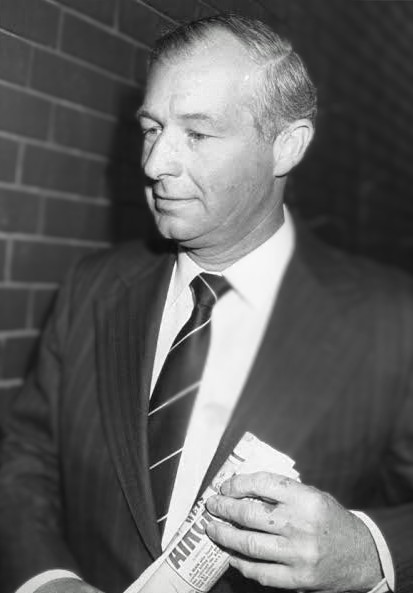 | ||
| Born | Roger Caleb Rogerson Born January 3, 1941 Sydney, New South Wales, Australia | |
| Died | Died January 21, 2024 (aged 83) | |
| Nationality | Australian | |
| Occupation(s) | Former police officer | |
| Years active | 1958–1986 | |
| Known for | Criminal activities, involvement in high-profile cases | |
| awards | Peter Mitchell Award for outstanding police performance (1980) | |
| Criminal charge | Bribery, conspiracy, and attempted murder | |
| Criminal penalty | Imprisonment | |
| Criminal status | Imprisoned | |
| Other names | Roger the Dodger | |
policeman. He was a hero – dashing and brave – yet in the end, he was found to be just another crook.
Roger Caleb Rogerson, the son of a British dock worker, joined the NSW police force as a cadet in 1958. From early in his career, he was identified as having the qualities to become an elite investigator.
For decades, the NSW police force promoted a star system where top investigators ended up dealing with high-profile cases. The competitive media quickly learned the police were fast-tracked to the 'A' team – detectives like the big-drinking Fred "Froggy" Krahe and quick-shooting Ray "Gunner" Kelly, who made his namesake, Ned, look like a choirboy when it came to crime.
NSW politicians, who rarely understood the idea of an independent police force, also liked to associate with hard detectives – hoping the tough law and order image would reflect favorably with voters.
This led to an unholy cooperative of senior police wanting results, reporters wanting headlines, and politicians wanting votes, encouraging the ‘stars’ without demanding accountability. That was the environment in which Rogerson thrived.
Early Life and Mentors
Some of Rogerson’s early mentors in the police force were infamous figures themselves. One of his first mentors was Superintendent Don Ferguson. In February 1970, Ferguson was found dead in the police headquarters toilets. The official version was suicide, although there were stories that his death was related to pressure over corruption.
Rogerson was also mentored by Fred "Froggy" Krahe, a well-known figure in the NSW police force. Krahe had a reputation for hard methods in getting results, and Rogerson learned many tricks from him. However, Rogerson always insisted that he ran his own race. By the 1970s, Rogerson had moved to the armed hold-up squad and was on duty when police shot dead a bank robber called Philip Western in 1977, and later, in 1979, when another robber, Gordon Thomas, was shot dead at Rose Bay. Rogerson was regarded highly in the force, winning the Peter Mitchell Award for outstanding police performance in 1980. However, as the 1980s progressed, his reputation began to tarnish. Rogerson became increasingly entangled in allegations of corruption, leading to his eventual downfall.
The Death of Warren Lanfranchi
Rogerson’s rise to notoriety involved a controversial shooting. In 1981, Rogerson went to arrest a known heroin dealer, Warren Lanfranchi. Lanfranchi’s girlfriend, Sallie-Anne Huckstepp, said he was unarmed and carrying $10,000 when he left to meet Rogerson. The money was never found. According to the police version of events, Lanfranchi drew a gun, and Rogerson had no choice but to fire two shots – one quick but fatal. Rogerson would later say he fired in quick succession, but two women who heard the shots estimated the gap was around 10 seconds. Police said Lanfranchi had pointed a gun at Rogerson, but the weapon was old, almost 90 years old, and defective. Why an experienced criminal such as Lanfranchi would carry such a useless weapon has never been explained. A coroner’s jury found that Rogerson had shot Lanfranchi while endeavoring to make an arrest, but they declined to find it was in self-defense or during the course of duty. It was the first time doubts arose about Rogerson’s methods – but not the last.
Huckstepp would lobby for years over the death of her boyfriend, claiming it was murder. She was later found dead in a lake at Centennial Park, Sydney, in February 1986. Her body had been strangled and hidden underwater in the shallows.
The Bribery of Mick Drury
In September 1983, undercover policeman Mick Drury was approached by Rogerson with a bribe over a Melbourne drug case. Drury declined the offer. In June 1984, Drury was shot and almost killed while standing in his kitchen at home. He was marked for death because he had refused the bribe. Rogerson’s connection to the attempted murder of Drury was repeatedly claimed in a series of court cases, where Rogerson was present when Christopher Dale Flannery, a notorious hitman, accepted the contract to murder Drury. The drug dealer who would later admit he had offered the bribe to Drury gave evidence that Rogerson was paid “most of” the $50,000 payment for the hit.
Decline in Rogerson’s Power
Rogerson’s power base began to erode over time. Even the NSW police force could no longer accept a man alleged to have tried to kill a colleague for cash. In mid-1985, Rogerson was photographed closing bank accounts and receiving cheques totaling $111,116.68. Police later found that the story Rogerson had used to justify the money – claiming it was from the sale of a vintage car – was a fabrication. This became a vital crack in Rogerson’s protective shield. While police and Royal Commissions would never nail Rogerson for attempting to bribe and then kill Drury, he would soon be snared over bank money.
Trial and Sentencing
In September 1987, Rogerson was charged with conspiracy to pervert the course of justice. The prosecution stated that Rogerson and others created a fake story to defeat the police inquiry into the accounts, by claiming $60,000 came from the sale of a car and the rest from gambling winnings. The prosecution asserted that the money came from illegal sources, possibly drug dealing by Rogerson. At the trial, a protected witness, known as ‘Miss X,’ stated she gave Rogerson a bag containing “bundles of money” at Sydney Airport in exchange for a bag containing about one kilogram of white powder. [1]
Death & Final Years
Roger Caleb Rogerson (3 January 1941 – 21 January 2024) was a former Australian police officer who gained notoriety for corruption, murder, and organized crime involvement. Rogerson died at the age of 83 at the Prince of Wales Hospital in Randwick, New South Wales, while serving a life sentence at Long Bay Correctional Centre.
During his imprisonment, Rogerson suffered from chronic health conditions including hypertension, cardiac failure, and cerebral amyloidosis — a disease causing bleeding in the brain and dementia. His health declined significantly in 2023, and he was transferred to the Aged Care Unit at Long Bay Hospital Correctional Centre.
On 18 January 2024, he was admitted to hospital after a severe brain haemorrhage and placed on an end-of-life care plan following consultations with his family. Rogerson died on 21 January 2024 from natural causes while in lawful custody. The coroner found that his medical care in custody and hospital was “timely and appropriate,” and that no concerns were raised by his family regarding his treatment.[2]