
Cryogenics
| Cryogenics | ||
 | ||
| Field | Physics, Engineering, Biology | |
| Primary focus | Behavior of materials at extremely low temperatures | |
| Temperature range | Below −150 °C (123 K; −238 °F) | |
| Applications | Superconductivity, rocket fuels, cryonics, medical preservation, quantum research | |
| Related disciplines | Cryobiology, Thermodynamics, Low-temperature physics | |
Cryogenics is the branch of physics and engineering concerned with the production and study of materials at extremely low temperatures, typically below −150 degrees Celsius (123 Kelvin). The term originates from the Greek words kryos meaning "cold" and genic meaning "to produce". Cryogenics explores how substances behave under near-absolute-zero conditions and has wide-ranging applications in science, technology, and medicine.
Overview
Cryogenics involves both the generation of very low temperatures and the effects of these temperatures on materials and biological systems. The field developed during the early twentieth century with the
liquefaction of gases such as oxygen and nitrogen, which allowed researchers to observe how extreme cold affects the physical and chemical properties of matter.
At cryogenic temperatures, atomic motion slows dramatically. Metals lose electrical resistance, enabling superconductivity, while biological activity nearly ceases. These effects make cryogenics essential to applications ranging from superconducting electronics to biological preservation.
Cryogenics and Biology
In biological research, cryogenics overlaps with cryobiology—the study of life processes under extreme cold. Experiments showed that individual cells and tissues could survive freezing if treated with cryoprotective agents such as glycerol, which reduces ice crystal formation and electrolyte damage.
Notably, researchers in the 1950s and 1960s demonstrated that frog sperm, mammalian tissue, and even small animals like hamsters could endure partial freezing and later recover normal activity.
Ettinger highlighted these studies as proof that freezing damage is not necessarily permanent, arguing that the preservation of human bodies could one day be biologically feasible.
Cryogenics and Cryonics
The extension of cryogenic principles to human preservation—known as cryonics—was popularized by Robert C. W. Ettinger in his 1964 book The Prospect of Immortality. Ettinger proposed that deceased individuals could be preserved at very low temperatures and later revived when medical science advanced enough to cure disease and repair cellular damage.
Ettinger wrote that “we need only arrange to have our bodies, after we die, stored in suitable freezers against the time when science may be able to help us.”Ibid., Chapter I, pp. 11–13.
Although speculative, Ettinger’s ideas helped establish cryonics organizations in the United States and inspired decades of research into reversible suspended animation and biological repair technologies.
Applications
Cryogenics is widely used across science and industry:
• Medicine: Cryosurgery, organ storage, and preservation of cells and embryos.[1]
• Physics: Superconducting materials, quantum computing, and particle research.
• Aerospace: Storage of liquid hydrogen and oxygen as rocket fuels.
• Food Industry: Rapid freezing to preserve flavor and nutrients.
• Electronics: Development of ultra-sensitive detectors and processors.
Safety and Materials
Cryogenic substances pose significant hazards if mishandled. Direct contact with liquid nitrogen or helium can cause severe cold burns, while materials exposed to such temperatures can become brittle and fracture. Proper ventilation is essential to avoid asphyxiation from displaced oxygen.[2]
Cryonics Key Concerns
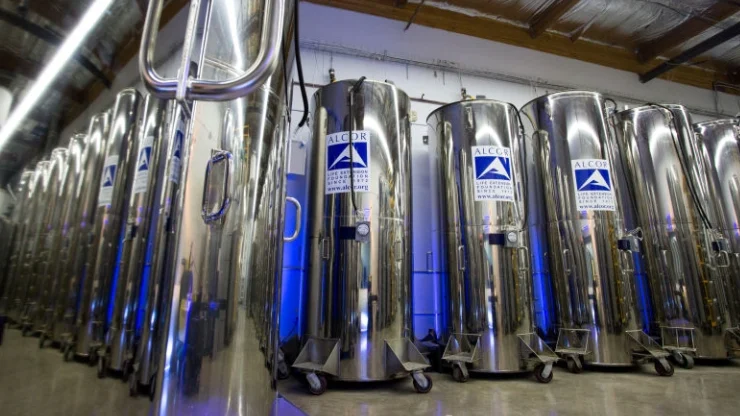
Cryonics, the preservation of deceased individuals at extremely low temperatures for potential future revival, raises several bioethical dilemmas. This practice, pioneered by Robert C. W. Ettinger in 1962 with his book The Prospect of Immortality, aims to defy permanent death through advances in medicine. However, it lacks successful human trials, with no revivals after over 40 years, leading some to label it pseudoscience that disrespects human dignity after death Akpan, Anthony.
Ethical issues include the absence of proven revival methods, the potential violation of dignity by delaying burial or "suspending" life akin to euthanasia, and the risk of eugenics due to its high cost favoring the wealthy. Additionally, secrecy and reports of mishandling, such as the Ted Williams case, fuel suspicion about organ integrity and family closure.[3]
References
- Robert C. W. Ettinger, ''The Prospect of Immortality'', Doubleday & Company, 1964, pp. 19–31.
- Robert C. W. Ettinger, ''The Prospect of Immortality'', Doubleday & Company, 1964, Preface by Gerald J. Gruman, pp. 2-28.
- Akpan, Anthony. "Some Issues with Cryonics." ResearchGate, September 2022, https://www.researchgate.net/publication/363882956