
Anthropornis nordenskjoeldi
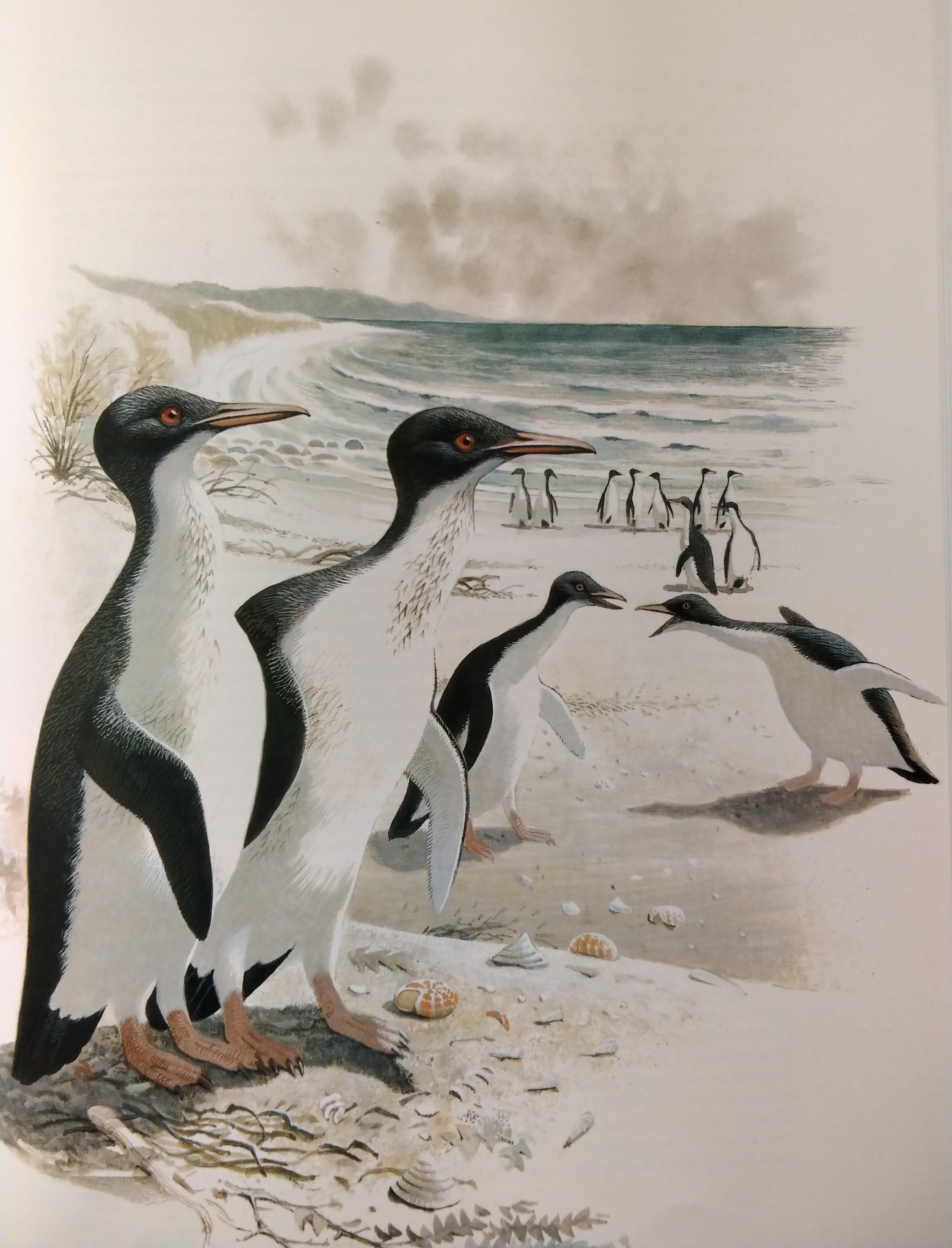
Anthropornis nordenskjoeldi, commonly referred to as Nordenskjoeld's Giant Penguin,
| Anthropornis nordenskjoeldi Temporal Range: Late Eocene – Early Oligocene | |
 | |
| Classification | |
| Genus | Anthropornis |
| Species | A. nordenskjoeldi |
| Fossil record | |
| Fossil range | Late Eocene – Early Oligocene |
is an extinct species of penguin that inhabited the southern hemisphere during the Late Eocene to the Early Oligocene. Its remains have been primarily found in the Antarctic and southern Australian regions. This species is considered one of the largest penguins known to science.
Discovery and Fossil Sites
The fossils of Anthropornis nordenskjoeldi have been found at multiple sites, including Seymour Island in the Antarctic Peninsula and Blanche Point in South Australia. The discovery of large wing bones resembling those of modern penguins but significantly larger confirmed the existence of this giant species. Fossils have also been identified in the Otway Peninsula in Victoria and Browns Creek in South Australia.[1]
The species was first described by Carl Wiman in 1905 based on fossils collected from Seymour Island. Later, findings in South Australia further supported its existence and suggested a broader distribution.[2]
Morphology
Anthropornis nordenskjoeldi stood approximately 1.7 to 1.8 meters tall and weighed significantly more than any modern penguin. Its flippers and wing structure, though similar in shape to modern species, were proportionally larger, allowing it to navigate effectively through ancient seas. These adaptations suggest that it was well-suited to colder climates and high-latitude marine environments.[3]
Significance of Blanche Point
Blanche Point, located 37 kilometers south-southwest of Adelaide, South Australia, has been a significant site for penguin fossils. Bones of Anthropornis nordenskjoeldi have been found in the Late Eocene formations, particularly in the Tuketja Member and the Gull Rock Member of the Blanche Point Formation. The fossils consist of wing bones, leg bones, and isolated fragments. These discoveries have helped paleontologists reconstruct the species' evolutionary history.[4]
Etymology
The genus name Anthropornis is derived from the Greek words "anthropos" (man) and "ornis" (bird), referring to its large size resembling a human's stature. The species name nordenskjoeldi honors Swedish explorer Otto Nordenskjöld.[5]
References
- Rich, P.V., Van Tets, G.F., Knight, F., ''Kadimakara: Extinct Vertebrates of Australia'', 1985, pp. 183-184.
- Rich, P.V., Van Tets, G.F., Knight, F., ''Kadimakara: Extinct Vertebrates of Australia'', 1985, p. 183.
- Rich, P.V., Van Tets, G.F., Knight, F., ''Kadimakara: Extinct Vertebrates of Australia'', 1985, p. 184.
- Rich, P.V., Van Tets, G.F., Knight, F., ''Kadimakara: Extinct Vertebrates of Australia'', 1985, pp. 183-184.
- Rich, P.V., Van Tets, G.F., Knight, F., ''Kadimakara: Extinct Vertebrates of Australia'', 1985, p. 184.